
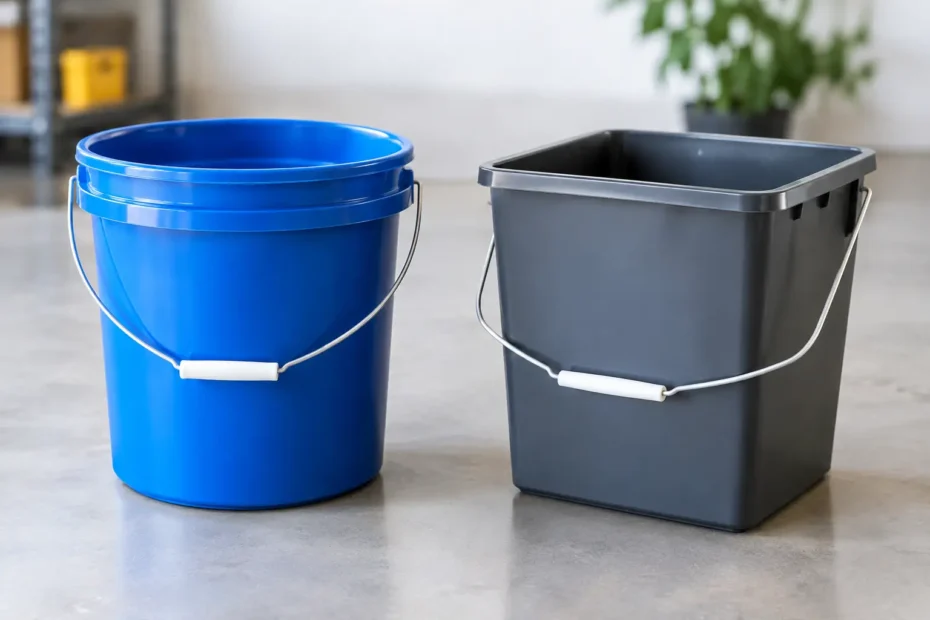
A bucket that fits the product but wastes space in storage can quietly increase handling and delivery costs. The choice between round versus square buckets affects more than appearance: it changes stacking efficiency, pouring performance, lid selection, cleaning, shelf presentation, and how easily staff can move goods through daily operations.
For commercial buyers, there is no single best shape. A round pail may be the practical option for liquid products and frequent mixing, while a square bucket can make better use of warehouse racks, delivery vehicles, and retail shelves. The right decision starts with the intended application, not simply the capacity printed on the container.
Round Versus Square Buckets: The Main Difference
Round buckets have continuous curved walls and are commonly used for cleaning chemicals, paint, food ingredients, adhesives, oils, and general household applications. Their shape is familiar, easy to manufacture, and well suited to products that must be stirred, scooped, poured, or washed out regularly.
Square buckets use straight sides and corners to maximize the space they occupy. They are often selected for storage, dry goods, powders, construction materials, packaging operations, and products that need to be arranged neatly on shelves or pallets. A square or rectangular footprint leaves less unused space when containers sit side by side.
Capacity alone does not tell the full story. Two buckets with a similar nominal volume can perform very differently once lids, handles, pallet layout, and product weight are considered. Procurement teams should compare external dimensions, wall thickness, lid fit, and load requirements before placing a bulk order.
When Round Buckets Are the Better Choice
Round buckets are a dependable option when easy handling matters more than maximizing every centimeter of storage space. Because there are no corners, liquid product moves more naturally when the bucket is tilted. This is useful for janitorial teams, maintenance contractors, paint suppliers, and facilities that prepare or dispense liquid solutions.
The curved interior also makes cleaning simpler. Brushes, mops, scoops, and mixing tools can reach around the inside wall without leaving material trapped in corners. For a cleaning-service operator handling detergents, disinfectants, or floor-care products, this can reduce residue and make reuse more practical where appropriate.
Round buckets can also be preferable for heavier contents. The circular form distributes pressure evenly around the container wall, which may support better performance under load when the bucket is made from suitable-grade plastic. Material quality still matters greatly. A durable HDPE or PP bucket, correctly matched to the product and weight, is more valuable than a thin container chosen only for its low price.
For retail and household use, round pails remain familiar to customers. They work well with standard handles and many common lid styles, including snap-on covers. If the product will be carried by hand, used daily, or opened and closed frequently, a round format often provides straightforward convenience.
Where Square Buckets Add Operational Value
Square buckets are designed for efficient use of space. Their straight edges allow closer placement on warehouse shelves, in storage rooms, and inside delivery vehicles. For businesses purchasing large quantities, the difference can be meaningful. Less empty space between containers can improve pallet utilization and reduce the number of trips needed to move the same volume of stock.
This advantage is especially relevant for retailers, wholesalers, food-service suppliers, and warehouse operators with limited storage capacity. Square buckets create cleaner rows, are easier to count visually, and can support a more organized presentation when multiple sizes or product variants are stored together.
Corners can also be useful for labeling and branding. Flat surfaces provide a practical area for printed labels, product instructions, batch identification, and handling information. Businesses packing dry ingredients, hardware, powders, granular materials, or specialty products may find that square buckets offer a more orderly package format.
There are trade-offs. Product can collect in the corners, particularly when the contents are thick, sticky, or powdered. Cleaning may take more attention than with a round bucket. A square design may also be less comfortable for certain hand-carrying tasks, depending on the handle position, weight, and container dimensions.
Choose by Product Type, Not Shape Alone
The material being packed should guide the decision. Liquids, cleaning solutions, paint, and products that require stirring often suit round buckets. Dry materials, packaged goods, components, and stock held on shelves may suit square buckets because of their efficient footprint.
For food-related applications, buyers should confirm that the bucket material, lid, and production standard are appropriate for the intended contact use. The same care applies to chemicals. A container must be compatible with the contents, particularly where solvents, concentrated cleaning agents, oils, or acidic products are involved. Never assume that any plastic bucket is suitable simply because it looks similar to another container.
Temperature also matters. Products filled hot, stored outdoors, or exposed to demanding industrial conditions need a bucket with suitable material strength and wall thickness. Handles and lids should be evaluated as part of the full package, since a strong container is of little use if the handle fails during transport or the lid does not seal properly.
Lids, Handles, and Stacking Affect the Final Choice
A bucket is not just a container body. The lid determines whether the product can be protected from dust, moisture, spills, and tampering. Snap-on lids are common for general storage and household products, while tighter-fitting options may be needed for products transported frequently or stored for longer periods.
Ask whether buckets must be stacked when full, nested when empty, or both. Empty round buckets often nest efficiently, helping reduce warehouse space before use. Square buckets can be excellent for full-container storage because they align closely on shelves and pallets. However, stacking strength depends on the design of the rim, lid, and base, not only on the shape.
Handle selection deserves equal attention. A light-duty household bucket may only need a basic plastic handle, while a heavier pail may require a stronger wire handle with a plastic grip. If workers routinely carry filled buckets across a site, handle comfort and attachment strength can affect safety and productivity.
Questions to Ask Before Ordering in Bulk
Before confirming a purchase, buyers should provide clear specifications to avoid receiving a container that is the right size but wrong for the job. Useful details include capacity, dimensions, color, material grade, lid type, handle type, expected product weight, and intended use.
It is also wise to request confirmation of available stock and consistent sizing across repeat orders. For distributors, retailers, and contractors, product continuity matters. A replacement bucket should fit the same shelf space, work with the same lid, and meet the same practical expectations as the previous supply.
At Doha Plastic House, commercial buyers can discuss bucket requirements directly with experienced sales staff before quotation and delivery coordination. This is particularly helpful when selecting between multiple capacities, colors, and bucket types for recurring operational use in Doha, Wakra, or Lusail.
Make the Purchase Decision Easier
Choose round buckets when pouring, mixing, rinsing, and hand-carrying are central to the job. Choose square buckets when warehouse organization, pallet density, shelf efficiency, and label space are the higher priorities. In many businesses, the practical answer is to keep both formats available for different departments and product lines.
A well-specified bucket prevents avoidable waste, damaged goods, and repeat handling. Start with what the container must do after it leaves the warehouse, then select the shape, material, lid, and handle that will keep your operation moving reliably.