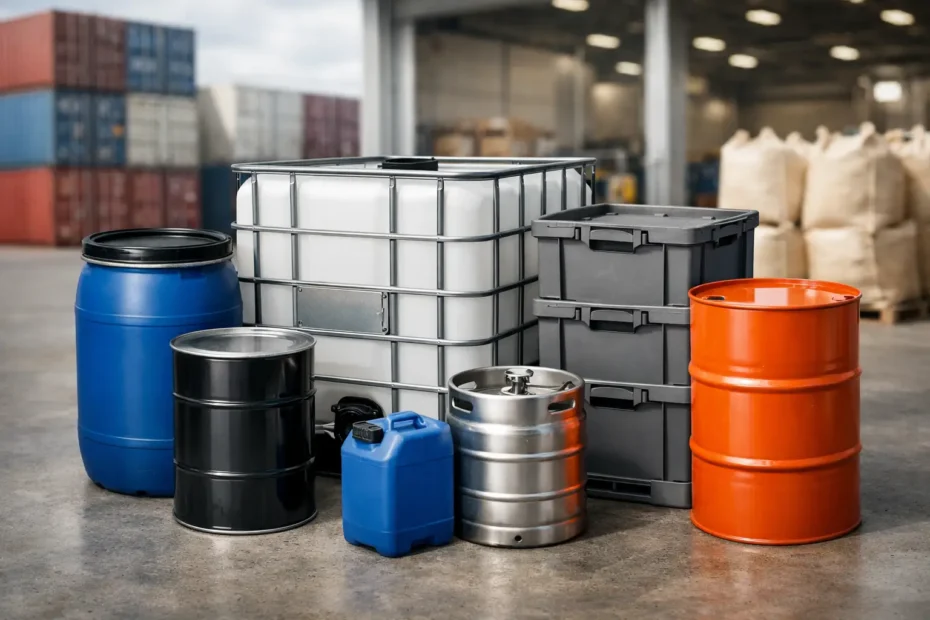
A container that looks suitable on a quotation sheet can fail quickly when it meets the wrong chemical, repeated forklift handling, outdoor heat, or heavy stacking. This industrial container material guide helps procurement teams match the container to the actual job before ordering by size, color, or price alone. For warehouses, cleaning contractors, retailers, food operations, and industrial facilities, the right material protects stock, reduces replacement costs, and keeps daily handling simple.
Start With the Product Being Stored
The first question is not, “What container is strongest?” It is, “What will this container hold, and how will it be used?” Water, dry goods, detergents, oils, waste, food ingredients, and industrial chemicals each create different requirements.
For example, a container used for dry components may need good stacking strength and a secure lid, while a container for liquid detergent needs a material that resists the formula, a reliable closure, and a shape that pours or dispenses safely. A waste bin has another priority: impact resistance, easy cleaning, and dependable performance through frequent use.
Always provide the supplier with the contents, expected fill volume, temperature range, whether the product is food-related, and whether the container will be moved by hand, pallet jack, forklift, or vehicle. A clear specification prevents a common purchasing mistake: selecting a container based on appearance rather than compatibility.
Industrial Container Material Guide: Main Options
HDPE: The Practical Choice for Many Liquids
High-density polyethylene, usually called HDPE, is one of the most widely used materials for industrial plastic containers. It is commonly used for jerry cans, drums, barrels, pails, bottles, and larger storage containers because it combines good impact resistance with a relatively light weight.
HDPE performs well with many water-based products, household chemicals, cleaning liquids, oils, and general industrial supplies. It does not rust, is easy to clean, and is often more practical to move than metal alternatives. For operations ordering repeated quantities, HDPE also offers a good balance between durability and wholesale cost.
However, HDPE is not a universal answer. Chemical compatibility depends on the exact product concentration, temperature, and storage period. A strong solvent or specialized chemical may require a tested grade, a different resin, or a lined container. Buyers should never assume that any HDPE drum is suitable for every liquid.
For outdoor use in Doha, Wakra, or Lusail, ask whether the container includes UV protection if it will remain exposed to sunlight for extended periods. Heat can also affect liquids inside the container, so storage location and ventilation still matter even when the plastic itself is durable.
Polypropylene: Useful for Heat and Repeated Handling
Polypropylene, or PP, is another common plastic used in pails, food containers, storage boxes, bins, and certain industrial packaging. It is valued for its stiffness, low weight, and stronger heat resistance compared with many standard plastic options.
PP can be a suitable choice when containers are cleaned regularly, used in warmer working areas, or required to maintain their shape during repeated handling. It is widely found in buckets, storage boxes, food-service containers, and components that need a firm, smooth finish.
The trade-off is that polypropylene may be less impact-resistant than HDPE in very cold conditions. That is less of a concern in Qatar than in colder markets, but heavy drops and rough loading can still cause damage. If the container will be thrown, dragged, or frequently handled on a construction or maintenance site, wall thickness and design are as important as the resin type.
PET: Best When Visibility and Presentation Matter
Polyethylene terephthalate, known as PET, is commonly used for clear bottles and lighter packaging. Its transparency makes it useful when customers or staff need to see the contents, fill level, or product condition without opening the container.
PET is often appropriate for consumer-facing packaged goods, beverages, and certain dry or liquid products. It can offer a clean presentation and efficient use of shelf space. For a retailer or distributor, clear packaging may improve stock identification and reduce handling errors.
PET is generally not the first choice for heavy-duty industrial storage, repeated rough handling, or high-impact applications. It is also less suitable where heat exposure is a major concern. Choose it for its clarity and packaging efficiency, not as a replacement for HDPE drums or heavy industrial pails.
Steel: Strength for Demanding Storage and Transport
Steel drums and containers remain relevant where high strength, rigid walls, and specific chemical or transport requirements are needed. They can be suitable for oils, solvents, paints, petroleum-related products, and other materials that require a stronger barrier or a more rigid package.
Steel handles stacking and heavy loads well, but it brings operational considerations. It is heavier than plastic, may corrode if the coating is damaged, and can raise transport and handling costs. A steel drum is often the better choice for a demanding product, but it is not automatically the most economical choice for general storage.
If steel is selected, confirm the internal lining, closure type, drum condition, and compatibility with the stored product. Reconditioned drums may work for some applications, while new drums may be necessary when cleanliness, product integrity, or formal specifications are critical.
Fiber Drums: A Dry-Goods Option With Limits
Fiber drums are generally used for powders, granules, dry food ingredients, pharmaceuticals, and other non-liquid products. They are lighter than steel and can be a practical packaging option when moisture protection is managed through liners or sealed inner bags.
Their limitation is clear: fiber drums do not offer the same resistance to water, rough outdoor exposure, or repeated wet cleaning as plastic or steel. They are best considered for controlled storage environments and dry contents, not for washdown areas or long-term outdoor placement.
Do Not Choose Material Without Checking the Design
Two containers made from the same material can perform very differently. A thin HDPE pail and a heavy-duty HDPE drum are not interchangeable. The shape, wall thickness, handle construction, lid fit, base design, and stacking profile all affect day-to-day performance.
A narrow-neck jerry can is practical for controlled pouring and transport of smaller liquid volumes. An open-top drum provides easier filling and access to powders or larger items. A tight-head drum is more suitable for contained liquids. Stackable plastic crates improve warehouse organization, while nesting bins can reduce empty-storage space.
For facilities and cleaning teams, consider the working routine. A mop bucket needs a stable base, durable handle, and a design that supports wringing or separation of clean and dirty water. A garbage bin needs a lid or pedal arrangement suited to the area, along with wheels if it will be moved while full. The material matters, but the equipment must also suit the task.
Check Load, Capacity, and Handling Method
Container capacity should not be confused with safe working load. A 20-liter pail filled with a dense liquid weighs far more than the same pail filled with a light product. The handle, lid, and bottom must support the real filled weight, not just the printed volume.
Ask how many filled containers will be stacked, whether pallets will be wrapped, and whether warehouse staff will lift units manually. A container that is affordable at purchase can become expensive if it cracks during loading, leaks in transit, or slows down the packing process.
For recurring industrial orders, standardizing a limited range of sizes can simplify storage, labeling, replenishment, and staff training. This is especially useful for cleaning companies, retail warehouses, and contractors that carry the same supplies across several sites.
Food, Chemical, and Hygiene Requirements
Where containers will contact food, ingredients, drinking water, or sensitive hygiene products, request the appropriate food-contact documentation and confirm that the supplied item is intended for that use. Do not rely only on a container’s appearance or color.
Chemical storage requires the same discipline. Share the safety data and chemical name with the supplier when possible, especially for acids, alkalis, solvents, concentrated detergents, and flammable products. Compatibility includes the container, cap or lid, gasket, dispensing tap, and any internal liner.
For sanitation programs, smooth surfaces and easy-clean designs can be as valuable as material strength. Containers that trap residue around lids, handles, or corners add time to cleaning routines and may shorten the useful life of the product.
Buy for Reliable Supply, Not a One-Time Fit
A suitable container is only useful if the same specification can be supplied again when stock runs low. Commercial buyers should confirm available colors, dimensions, lid options, minimum order quantities, and expected delivery schedule before approving a line item.
At Doha Plastic House, quality checks before delivery and access to a broad range of containers, drums, pails, crates, and cleaning products help buyers source practical supplies through one trade partner. For larger or repeat orders, approving a sample or specification sheet first can prevent avoidable differences between batches.
The best purchasing decision is usually not the cheapest container or the heaviest one. It is the container material and design that safely fits your product, handling method, storage environment, and reorder plan – then continues to perform after the first delivery.